
Sunday, May 15, 2016


Thursday, February 21, 2013
Sunday, February 17, 2013
News Flash
Don't miss Global News special on Passive House construction
in Canada with The Reno Coach Reiner Hoyer
on Thursday at 6:30pm Toronto time.

Reiner Hoyer
Direct Line 416-833-3000
Tel/Fax 1-888-688-8864
Toronto, Ontario
Sunday, December 30, 2012
How long can a 1 cbm Ice cube last inside a Passive House

Michelstädter Ice Cube Bet
7th September – 7th October
On 7th September 2012, in front of the historic town hall in Michelstadt a wooden house was erected, designed by Michelstädter planners and builders. The expert design, high quality materials and good construction ensure the perfect insulation performance – Passive House Standard. Inside the house there is 1 m³ of ice for a month to brave the late summer temperatures.

What do you think?
What percentage of ice is left on the 7th October 2012?
Bet and win attractive prizes at
Schedule of Ice Cube Bet:
07.09.2012
Start at 6.00pm
19.09.2012
Information booth on the Hessian Sustainability Day
07.10.2012
1.30pm break up with official weighing and detailed discussions with experts at Michelstädter Weinbrunnenfest
Insulating is protecting the climate with personal benefit!
The Ice Cube shows what quality insulation can afford. After all, good insulationnot only prevents the ice cube from melting. If summer heat does not come from the outside to the inside, in winter it keeps the heat inside.
The result: reduced energy use.

The Ice Cube Bet is housed in a timber frame construction. Walls and ceilings are insulated with cellulose. For the timber frame construction “Dämmständer” were used. The total wall thickness is 53 cm. The ice cube is placed on Isoquick – The Insulated Raft – which is also used for reinforced concrete slabs.
To show what happens to the ice cube within four weeks, the house was equipped with a 3-pane window that satisfices Passive House Standard.
The airtight building envelope and the thermal bridge free construction are important aspects of planning and execution. Because the house is “inhabited” only by a cube of ice a ventilation system with heat recovery is unnecessary, although it is essential for Passive House Standard.
Friday, October 5, 2012
Thursday, September 20, 2012
Interview with Reiner about his passive House in Moneysense Magazine
The home energy makeover
Want to slash your monthly bills in half? These simple improvements will save you thousands on electricity, gas and water.

We Recommend
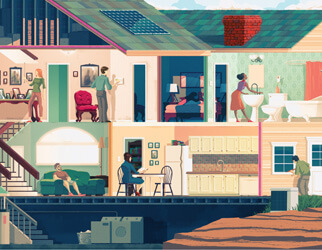
Two years ago Reiner Hoyer lived in a squat 1950s-style bungalow in the north end of Toronto. Like most houses of that era, it was drafty, poorly insulated and cost a fortune to heat and cool each year. Today the bungalow has been transformed into a two-storey home, complete with three large bedrooms, hardwood floors and a basement apartment. But despite more than tripling the size of his home, Hoyer’s utility bills are about $1,200 for the year, a third of what he spent on his old bungalow, and less than half the national average.
Hoyer, a renovation consultant, took advantage of the latest energy-saving technology to dramatically lower the cost of living in his home. He doesn’t even have a furnace: triple-paned windows, super-insulated walls and solar panels are some of the features that keep his house comfortable year round. Hoyer also cut his water bill by installing a rainwater cistern in his backyard to supply his toilets. Not only is his home one of a kind, it’s one of the most energy-efficient homes in the country.
The average homeowner spends $2,234 a year on water, gas and electricity, costs that are likely to rise as we run out of cheap energy and our power grid starts showing its age. While Hoyer may have gone to extremes, there are many cheap and easy upgrades regular homeowners can do to reduce monthly expenses. In the pages that follow, you’ll visit our energy-efficient house, where we cost out exactly how much you’ll save for each home improvement. We hope you’ll get some ideas you can put into practice. Not only will you start seeing a payback almost immediately, you’ll also add to the long-term value of your home.
Sunday, August 19, 2012


Wednesday, May 23, 2012
Bavaria requieres new Government Buildings to meet passive house standard
Second Cabinet approves plan for more efficient energy standards for public buildings / Interior Minister Herrmann: "reduced energy-efficient design and construction of energy demand of buildings considerably / concept for the construction of state-Licher energy efficient property state buildings makes sustainable / Free State as a public client performs a role model," the video statement
The Council of Ministers has today decided to continue in government buildings a much more efficient than standard power to lay the basis previously. Interior Minister Joachim Herrmann: "The Bavarian energy plan, energy innovation ', we have set ourselves ambitious goals. Remain even after the phasing out of nuclear energy and the transition to renewable forms of energy, energy must be safe, affordable and environmentally friendly. Against the background of the energy revolution, today's decision of the Cabinet on energy standards for state buildings has ripple effect on our efforts to save energy. It is an important contribution to increasing energy efficiency and thus to achieve the Bavarian climate goals. "
The concept approved by the Cabinet of the Minister of the Interior states that new administrative building of the Free State on a regular basis on the basis of the passive house standard run. So apply for future government buildings such as building offices, tax offices, survey offices and police stations also highest in terms of energy efficiency requirements. Moreover, the concept before the Interior Ministry that the government planned construction projects - both new construction and in the inventory - the requirements of the Energy Conservation Act 2009 must be less about the building envelope in general at least 30 percent. The higher requirements are not only exceptionally be applied if the individual economic, technical or user-related reasons to the contrary. In a pilot phase, selected individual special buildings - such as the Institute building - to be built into the sophisticated passive house standard. In this complex new buildings scientific monitoring for evaluation and evaluation will be consulted.
Interior Minister Herrmann: "Our concept for more efficient energy standard, we make the government building for the future. In addition, the Free State shall be a public visible client's true role model. "Interior Minister Herrmann pointed out that flow into Germany more than 30 percent of the energy in the heating of buildings. In Bavaria, the heat supply causing almost 30 million tonnes, about 35 percent of energy-related CO2 emissions."Through energy-efficient design and construction can the energy demand of buildings is significantly reduced. Also, given the significant share of energy costs in state budgets, I believe it is essential to consider the cost of construction based on a synopsis of investment and operating costs, including environmental costs, "said the Minister. The passive house standard reduces the current state of the art - thanks to an optimized and highly efficient building envelope technology - the energy requirements of buildings to a minimum. Associated costs in the investment of an average of eight percent are covered by long-term savings in energy costs. The shortfall of EnEV requirements by 30 percent leads to additional costs of up to two percent.
Already in 2008, the State Building Authority was established in Bavaria because of a cabinet decision in anticipation of the future EnEV 2009, their stringent requirements for state construction projects. Herrmann: "The new regulations, we are today in terms of future requirements for the construction on a major step back and take it to other federal countries
The Council of Ministers has today decided to continue in government buildings a much more efficient than standard power to lay the basis previously. Interior Minister Joachim Herrmann: "The Bavarian energy plan, energy innovation ', we have set ourselves ambitious goals. Remain even after the phasing out of nuclear energy and the transition to renewable forms of energy, energy must be safe, affordable and environmentally friendly. Against the background of the energy revolution, today's decision of the Cabinet on energy standards for state buildings has ripple effect on our efforts to save energy. It is an important contribution to increasing energy efficiency and thus to achieve the Bavarian climate goals. "
The concept approved by the Cabinet of the Minister of the Interior states that new administrative building of the Free State on a regular basis on the basis of the passive house standard run. So apply for future government buildings such as building offices, tax offices, survey offices and police stations also highest in terms of energy efficiency requirements. Moreover, the concept before the Interior Ministry that the government planned construction projects - both new construction and in the inventory - the requirements of the Energy Conservation Act 2009 must be less about the building envelope in general at least 30 percent. The higher requirements are not only exceptionally be applied if the individual economic, technical or user-related reasons to the contrary. In a pilot phase, selected individual special buildings - such as the Institute building - to be built into the sophisticated passive house standard. In this complex new buildings scientific monitoring for evaluation and evaluation will be consulted.
Interior Minister Herrmann: "Our concept for more efficient energy standard, we make the government building for the future. In addition, the Free State shall be a public visible client's true role model. "Interior Minister Herrmann pointed out that flow into Germany more than 30 percent of the energy in the heating of buildings. In Bavaria, the heat supply causing almost 30 million tonnes, about 35 percent of energy-related CO2 emissions."Through energy-efficient design and construction can the energy demand of buildings is significantly reduced. Also, given the significant share of energy costs in state budgets, I believe it is essential to consider the cost of construction based on a synopsis of investment and operating costs, including environmental costs, "said the Minister. The passive house standard reduces the current state of the art - thanks to an optimized and highly efficient building envelope technology - the energy requirements of buildings to a minimum. Associated costs in the investment of an average of eight percent are covered by long-term savings in energy costs. The shortfall of EnEV requirements by 30 percent leads to additional costs of up to two percent.
Already in 2008, the State Building Authority was established in Bavaria because of a cabinet decision in anticipation of the future EnEV 2009, their stringent requirements for state construction projects. Herrmann: "The new regulations, we are today in terms of future requirements for the construction on a major step back and take it to other federal countries
Thursday, May 17, 2012
Back yard Deck Idea's Glass Railing and Awning
 |
| Back yard Deck Design with Glass Railing and retractable Awning |

Saturday, March 31, 2012
Grand Opening Showroom 1194 Caledonia Rd.
Don't miss Grand opening
of 7Dimensions Today March 31 @ 10 am to 4 pm 1194 Caledonia Rd Unit E
i Pad 3 Draw Free
Patio #Door 50% off Tiles

of 7Dimensions Today March 31 @ 10 am to 4 pm 1194 Caledonia Rd Unit E
i Pad 3 Draw Free
Patio #Door 50% off Tiles


Friday, March 16, 2012


Saturday, March 10, 2012
Catching the crocked Repair Contractors
You need to Watch this it wall turn your stomach inside out
the shocking truth about repair contractors.
Your morning Coffee will never be the same
http://www.cbc.ca/marketplace/2012/whentherepairmanknocks/
Thursday, March 8, 2012
Das Haus Show April 13 - 22, 2012 in Toronto
From April 13 – 22, 2012, the DAS HAUS team welcomes green building professionals in Toronto to visit a 10-day exhibition on German sustainability technologies. The program offers a number of high-profile expert symposiums, networking functions and guided tours allowing visitors to discover new energy-efficient technologies and share perspectives on sustainable building practices.
The DAS HAUS conference The Net-Zero House – Learning from Canadian and German experiences is scheduled for Friday, April 13 from 12.30 – 5.30 pm. The conference speakers will discuss emerging opportunities for advancing green building and energy efficiency concepts.
Following a guided tour of the DAS HAUS pavilion, the conference will be held at the Allstream Centre.
Tuesday, March 6, 2012
Lighthouse Project in Denmark largest thermal energy storage
In the Danish Braedstrup currently Europe's largest borehole thermal energy storage arises seasonal combined with a huge solar thermal system. For this purpose, expands the existing solar field is strong, so that by the low heat demand in summer creates a large surplus of heat. To this energy in the winter to make use of a seasonal borehole thermal energy storage with 50 RAUGEO probes from PE-Xa is built, the stores at a depth of about 48 meters, the excess heat.
The operation of the store is simple: In the summer of the solar system circulates the heated water up to 85 ° C in the probes. It heats the surrounding area and creates a giant heat store. In winter, when the heat is then required for the municipal district heating, it is routed back into the circulating water and extracted via a heat pump.
The high temperatures that arise in the solar collectors, heat exchange system must be highly temperature-resistant to heat transfer into the soil. The leaders therefore decided to RAUGEO probes made from PE-Xa, because they can withstand high operating temperatures of up to 95 ° C. In combination with the REHAU compression sleeve jointing technique, they provide under these extreme conditions of long-term maximum security and are due to the specific material properties of PE-Xa highly resistant to dents, scratches and point loads. Working closely with Solites, Institute for long-term heat storage, as well as the local planning agencies PlanEnergi / GEO REHAU could contribute its extensive expertise in high-temperature probes from the start.
The first extension is not the end: It is planned to install in the final stage of the project, a total of 60,000 square meters of solar collectors and 300-400 probes for the storage of heat. So then a solar contribution of an estimated 60 percent of the total annual energy consumption is achieved.

Sunday, March 4, 2012
Today I installed the Brine heat Exchanger in the intake Air of the HRV
 |
| Temperature inside house after Air passed through ground loop +9.1Celsius |
 |
| After Brine loop heat exchanger +12.7 celsius |
 |
| Temperature at outside Air intake |
Pictures of how well our new insulated Blinds work
 |
| Our triple pane windows doing a good job blocking out cold the insulating blinds are perfecting it Wall is R 70 insulation value less than 1 degree difference. |

 |
| Same Picture as above with Thermo imager camera almost same temperature as the R70 wall |
 |
| See Picture below for proof of how well this Blinds work blocking cold out |
 |
| Perfect insulation Values from our new Hunter Douglas blinds seen with a Thermo imager camera Blinds supplied and installed by http://www.smartblindsandfloorings.com/ |
Saturday, February 11, 2012

How well does a ground loop work in sync with the world best HRV
Today on a very cold winter day I messure the temp of my Air intake and out flow after going through the Paul HRV Novios 300
The ground loop takes a frezzing - 16.3 C up to +3.5C before entering the coil
of the HRV wich removes all the heat from the air leaving the house
except for 0.1C.
A true live performance test I like to know any one wich can show me a better HRV system.
 |
| Intake Temp at Ground loop pipe intake -16.3 Celsius |
 |
| Temp inside air at point of entry of House + 3.5 Celsius |
 |
| Temp at exit of House after Air has passed through Paul Novis 300 HRV 3.6 celsius |
Thursday, February 2, 2012
How can this little Pump save 50 000 liter water a year for the houshold
This little circular pump is inline with the Hot water line at the hot water Tank. A special thermal Bypass comfort Valve installed under the sink furthers away from the Tank allows water to flow from the hot line in to the cold line till the hot water reaches the Valvue.
Saving 1000's of liter of water going town the drain
never wait for Hot water again.

Tuesday, January 31, 2012
Less than a cup of coffe a day to heat our passive house
I can't believe only $20 for backup heat from our air heat pump for month of jan.
Subscribe to:
Posts (Atom)